


When cold chain packaging fails, the impact starts immediately. Temperature changes trigger batch rejections, regulatory investigations follow and customer contracts come under review due to compromised product reliability.
In these moments, the issue is rarely the product alone. It’s the reliability of every part of the cold chain system that supports it in transit.
Good manufacturing practices (GMP) certification reduces this problem by proving that a supplier operates under controlled, audited conditions rather than informal or undocumented practices. For procurement, quality and supply chain teams, GMP certification provides confidence that manufacturing outcomes are predictable and repeatable at scale.
What Is GMP Certification?
GMP certification confirms that a manufacturer consistently produces and controls products according to defined quality standards that protect safety, purity and performance. The definition of GMP aligns with guidance from the World Health Organization, which describes good manufacturing practices as a system intended to control risks that can’t be eliminated through final product testing alone.
From a decision-making standpoint, GMP certification functions as third-party validation of a supplier’s operating discipline. It verifies that documented procedures, trained personnel, controlled facilities and management oversight are in place and active every day, not just during audits.
Practices vs. Processes
Buyers often evaluate suppliers by focusing on individual production steps such as mixing, filling, sealing or packaging. These steps are informally referred to as good manufacturing processes. In regulatory terms, they’re individual operations governed by a broader system of good manufacturing practices.
GMP certification doesn’t approve individual steps in isolation. It validates the framework that controls how those steps are performed, monitored, documented and corrected when deviations occur.
The framework includes:
- Training programs
- Sanitation requirements
- Documentation standards
- Change management controls
- Corrective action systems
The Scope of GMP Certification
For buyers, the scope of GMP certification defines which risks are actively controlled by the supplier.
Certification applies to:
- Raw material sourcing
- Supplier qualification
- Facility and equipment design
- Environmental controls
- Employee hygiene and training
- Manufacturing operations
- Packaging and labeling
- Warehousing and distribution
The breadth of coverage matters because quality failures rarely originate in a single step. GMP certification confirms that all variables capable of affecting product integrity are managed within a single, integrated system.
Why Is GMP Important When Choosing a Business to Work With?
GMP certification removes uncertainty from supplier selection. Certification confirms that manufacturing controls are already verified, documented and independently assessed.
Risk Mitigation Through GMP Compliance
GMP compliance functions as a preventive safeguard for procurement and quality teams. An uncertified supplier may operate with undocumented changes, inconsistent sanitation or limited traceability. Operating without these controls increases the risk of batch failures, shipment rejections and regulatory findings.
A compliant manufacturer demonstrates that risks are identified, monitored and managed within their own systems before products move downstream. This reduces the chance that quality issues become the buyer’s problem to resolve.
Vendor Accountability and Internal Oversight
Working with a GMP-certified supplier shifts responsibility for quality control back to the manufacturer. Certification confirms that the supplier maintains:
- Internal audit programs
- Deviation management
- Corrective actions Management review
Instead of relying on buyer-driven endorsement, accountability is embedded within the supplier’s daily operations. For procurement, this means fewer emergency interventions and a clearer division of responsibility when issues arise.
Cold Chain and High-Risk Packaging
Making cold chain shipping mistakes directly affects buyer risk. For example, if a gel pack leaks, freezes unevenly or underperforms during transit, high-value pharmaceuticals or biologics may become unusable.
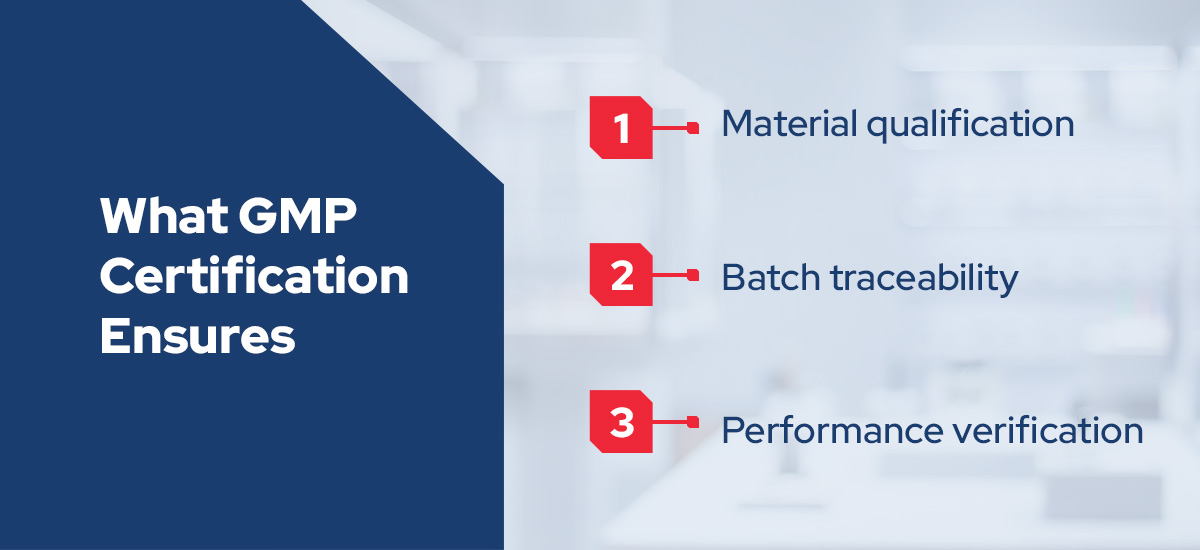
GMP certification ensures packaging material and finished units follow validated good manufacturing process controls, including:
- Material qualification
- Batch traceability
- Performance verification
GMP Regulations and What Goes Into Becoming GMP Certified
GMP regulations and certification programs define the operational criteria used to evaluate whether a manufacturer maintains control over production activities. Becoming GMP certified involves an independent assessment against an established GMP standard, with emphasis on whether documented systems operate as written and remain effective over time.
Documentation and Traceability
GMP regulations require manufacturers to maintain comprehensive, lot-level records that support investigations, recalls and regulatory review. To meet these requirements, manufacturers commonly maintain the following documents and controls:
- Recording processing conditions, deviations and test results for each production run.
- Retaining deviation, investigation and distribution records for inspection and compliance review.
- Conducting internal document reviews to confirm alignment between written procedures and actual operations.
- Operating recordkeeping systems that preserve data integrity, ensure retention and allow timely retrieval during audits and inquiries.
Hygiene and Sanitation Controls
GMP regulations establish expectations for sanitary operations and contamination control appropriate to the product and facility. To meet these expectations, manufacturers typically implement hygiene and sanitation controls as part of a compliant GMP program:
- Written cleaning and sanitation procedures covering equipment, utensils and facility areas
- Employee hygiene programs supported by training and enforced gowning practices in controlled environments
- Pest management programs supported by monitoring activities and documented corrective actions
- Facility layouts, material flow controls and environmental practices intended to minimize contamination and cross-contamination risk
Process Validation
Regulatory guidance and GMP expectations require companies to demonstrate that their manufacturing processes operate in a state of control and consistently deliver results. Validation activities commonly used to meet these expectations include:
- Written protocols detailing critical process parameters, acceptance criteria and evaluation methods
- Execution of validation studies under normal operating conditions and defined challenge scenarios
- Documentation of validation outcomes with formal change control governing process modifications
- Periodic review of performance data to confirm continued validation status
Ongoing Monitoring and Corrective Action
GMP expectations and quality-system standards require ongoing oversight to maintain control after certification. Manufacturers commonly meet these expectations through these activities:
- Regular internal audits and trend analysis of quality and process performance data
- Documented investigations into deviations and nonconformances using root cause analysis
- Corrective and preventive actions are monitored to ensure implementation and effectiveness
- Management review activities focused on system performance and continuous improvement
Work With Pelton Shepherd
Cold chain failures often stem from packaging manufactured without consistent controls, creating risk that procurement absorbs through rejected shipments, audits and supply distribution.
Pelton Shepherd is Hazard Analysis & Critical Control Point certified and addresses risk through GMP-certified manufacturing across eight U.S. facilities. We apply uniform controls for materials, formulation, sealing and thermal performance at every site. GMP-certified production turns cold chain packaging into a verified part of the distribution system rather than an assumed safeguard.
Contact us to discuss your temperature-sensitive shipping requirements. Our team supports your cold chain strategy by ensuring packaging performance remains controlled, documented and repeatable.