


When a business’s cold chain packaging fails, the impact is immediate. Temperature fluctuations lead to batch rejections, customer contract review and regulatory investigations.
International Safe Transit Association (ISTA) standards validate whether cold chain shipping systems can withstand real-world transit and maintain temperatures. Learn about these regulatory expectations across pharmaceuticals, biologics and perishable food.
What Are ISTA Standards?
ISTA is the global authority on transport packaging standards. Rather than regulating businesses directly, ISTA develops standardized testing procedures. These protocols test packaging performance under simulated real-world conditions.
ISTA testing standards address different validation needs:
- 1-Series: Non-simulation integrity screening for basic package durability.
- 2-Series: Partial simulation testing for lighter-weight shipments.
- 3-Series: General simulation of transport hazards including drops, vibration, compression and atmospheric conditioning.
- 4-Series: Enhanced or customized simulation for specialized applications.
- 6-Series: Member-specific testing protocols developed with retailers like Amazon and Sam’s Club.
- 7-Series: Development tests for thermal transport, including 7D and 7E standards that validate thermal testing performance.
Pharmaceutical experts developed ISTA 7E and Standard 20 to meet Food and Drug Administration (FDA) regulatory expectations. These standards use thermal profiles from data spanning 82 real-world shipping lanes. When a package has an ISTA certification mark, you know it has been validated through standardized testing.
How ISTA Standards Apply in the Cold Chain
ISTA’s standards are applicable across several industries. However, they are most consequential in cold chains, where packaging failure can mean significant food waste or compromised patient outcomes.
ISTA Standards for Pharmaceuticals
Standard 20 and 7E provide the primary framework for insulated shipping containers (ISCs). Compliance is a vital step in the pharmaceutical industry, where approximately 48% of products require temperature-sensitive shipping. In higher-income countries, 38% of vaccine shipments were exposed to temperatures below recommended guidelines.
The ISTA Pharma Committee offers peer-reviewed guidance for qualifying thermal packaging. This includes packaging qualification (PCG-01), operational qualification (PCG-02), performance qualification (PCG-03) and ambient temperature profiles (PCG-04). These documents are recommended for businesses validating FDA-regulated ISC thermal performance.
When broken, end-to-end cold chain noncompliance leads to economic damage and even risks to patient health. As such, shipping pharmaceuticals demands documented, repeatable packaging performance.
ISTA Standards for Food and Perishables
Food and perishable shippers more commonly use ISTA’s 3-Series tests. These simulation tests account for transport hazards, such as drops, vibration, compression and atmospheric conditioning. However, Standard 20 remains relevant to thermal packaging performance.
Improper refrigeration is the primary factor in 20% of global food loss. Thus, cold chain logistics play a vital role in ensuring food safety, especially for products that are easily damaged by temperature fluctuations. These ISTA standards give food shippers a framework for packaging performance.
Businesses shipping meal kits and groceries need reliable packaging. It must perform consistently under varying transit conditions and comply with cold chain shipping regulations.
ISTA Compliance and Regulatory Requirements
ISTA is not a regulatory body, so it does not issue citations or enforce laws. However, its standards are referenced by the bodies that do. For instance, the FDA references ISTA 3A for packaged medical devices. Regulations for food and medicine safety are tightening. This has driven the increasing demand for standardized, documented packaging validation.
Intelligent logistics planning is essential for product integrity, waste reduction and regulatory compliance. Fortunately, ISTA compliance gives businesses a defensible record of packaging performance. They can refer to certified labs, documentation and qualification processes to verify performance.
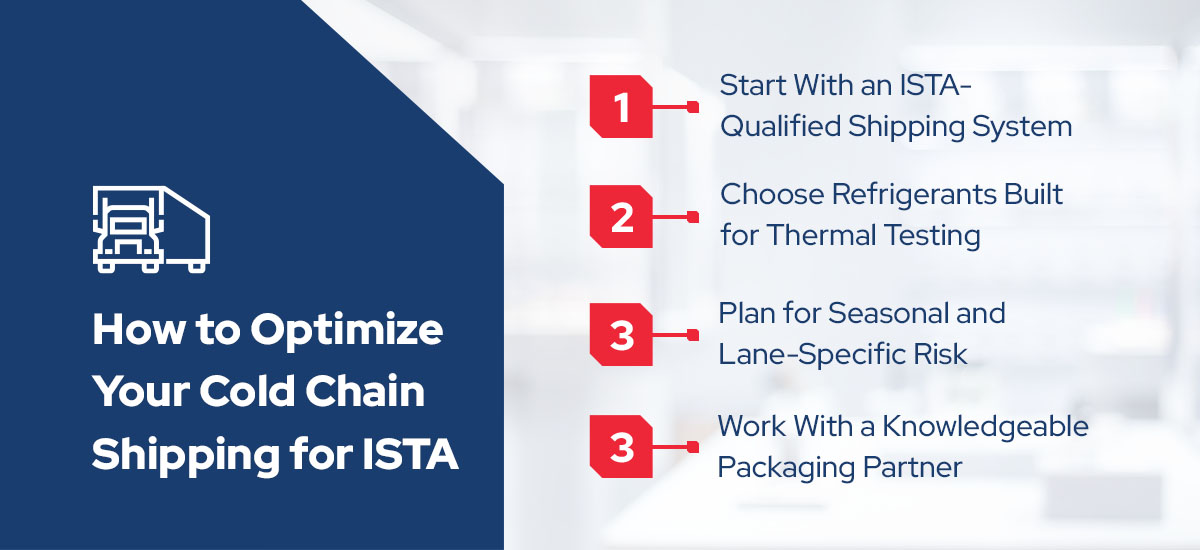
How to Optimize Your Cold Chain Shipping for ISTA
Understanding which ISTA standards your shipments require is the first step. Next, you’ll want to build a reliable, compliant packaging system. This is where operations, refrigerant selection and partner expertise come together.
Start With an ISTA-Qualified Shipping System
The Standard 20 qualification process is the foundation of compliant packaging. This process includes three stages:
- Design Qualification (DQ): Plans initial chamber size and materials.
- Operational Qualification (OQ): Tests the packaging under controlled conditions.
- Performance Qualification (PQ): Validates real-world shipments in extreme seasonal temperatures.
Starting with a Standard 20-qualified ISC means the packaging is proven to perform under real-world conditions. An ISC’s outer box, thermal insulation, refrigerant and temperature-sensitive payload are all validated together.
Choose Refrigerants Built for Thermal Testing
When designing compliant cold chain packaging systems, make sure to choose the right refrigerant. Whether gel or ice packs, refrigerants must maintain consistent thermal performance across DQ, OQ and PQ stages. Inconsistent or underperforming refrigerants can lead to a failed qualification.
Businesses should account for:
- Consistent eutectic temperature: The thawing temperature that determines how long a gel pack will maintain controlled temperature.
- Puncture resistance: All gel packs used in ISTA testing environments should have puncture-resistant exteriors. This aids in maintaining packaging integrity through distribution testing.
- Transit compatibility: Refrigerants must be compatible with the product’s required temperature range and transit duration.
- Extreme conditions: Refrigerant performance must hold across both summer and winter profiles during testing. Businesses should select refrigerants validated for worst-case seasonal conditions, not just average conditions.
Plan for Seasonal and Lane-Specific Risk
ISTA 7E includes distinct summer and winter thermal profiles, built from real-world shipping lane data. Businesses must plan for both worst-case conditions. A packaging system that passes summer qualification but underperforms in winter is not fully compliant.
Different shipping routes carry different temperature exposure profiles. ISTA’s thermal lane data allows businesses to model scenarios before committing to a packaging system.
The ISTA Thermal Lane Data Package also allows businesses to run real-world simulations of ISC performance. This testing can make all the difference in your packaging decisions.
Work With a Knowledgeable Packaging Partner
ISTA compliance requires interconnected decisions across ISC design, refrigerant selection and seasonal lane planning. Your documentation must hold up under regulatory scrutiny. This is where a reliable packaging partner comes in.
An expert partner helps businesses avoid trial-and-error testing cycles. They can guide your refrigerant selection, helping you choose ones proven to perform in specific shipping conditions. This way, you can build a packaging system that passes qualification the first time.
Industry expertise helps reduce the risk of failures that require retesting and cause delays. The ideal partner brings decades of experience optimizing cold chain packaging, applying that expertise to your specific needs.

Choose Pelton Shepherd
Navigating ISTA compliance requires more than checking boxes. It requires coordinated decisions across ISC design, refrigerant selection, seasonal planning and documentation.
Pelton Shepherd brings more than 70 years of cold chain packaging expertise. Our gel packs and ice packs are engineered with puncture-resistant exteriors. We design packaging for predictable thermal performance under demanding ISTA conditions. Businesses across the pharma industry, including Optum, CVS and Express Scripts, rely on our consistent refrigerant solutions.
Whether you’re optimizing your packaging system or testing a new one, we’re here to help. Together, we can build a cold chain shipping solution that passes the first time. Contact our team today to get started.